Worker-Trainer Spotlight: Eddie Sharpe talks about injuries and training
March 26, 2026

Eddie Sharpe has been working in the paper making industry for over 30 years. His union experience goes all the way back before the Paper-Allied, Chemical and Energy Workers Union (PACE) and United Steelworkers (USW) merger in 2005.
He’s a member of USW Local Union 9-1441 in Valley Grande, Ala., where he currently serves as the department grievance chair. Sharpe has held multiple positions in the local, including local president for three terms (nine years). He’s been a USW Tony Mazzocchi Center (TMC) worker-trainer for 14 years, and a USW Specialized Emergency Response Team (SERT) member for 13 years. Before doing health and safety work for the union, Sharpe served as casual staff for the USW Education Department.
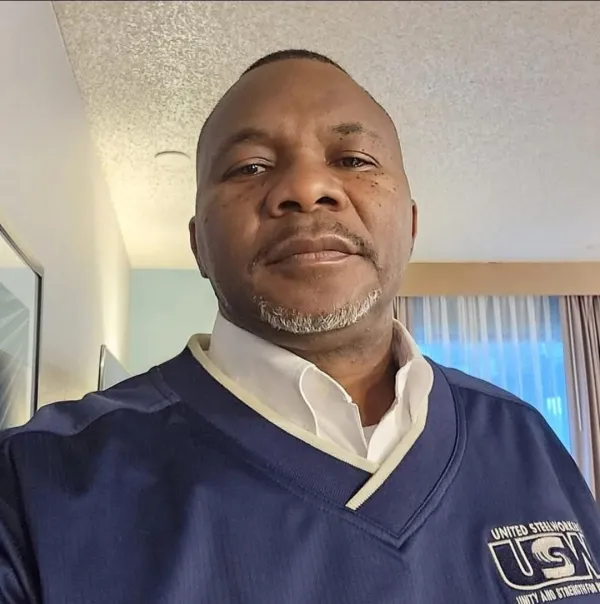
Rodrigo Toscano: Great to be talking to you, Eddie. Thanks for taking the time.
Eddie Sharpe: No problem, brother.
RT: Eddie, how did you first get into doing health and safety activism for the union? What would you say was your jump off moment? I say, “jump off,” because I remember you telling me about your parachuting experiences when you were in the military at last year’s USW Health, Safety and Environment Conference in Pittsburgh.
ES: (laughing) right, man. Crazy stuff. Well, if I go all the way back to my early employment at a paper mill, I was employed at this company a little over a year and a half when something happened. Are you familiar with paper operation? At the time, we used to have what we call “butt rolls.”
RT: What?
ES: (laughing) Let me explain. Those “rolls” are the paper that’s left over on a core after the majority of the paper has been used in production. They’re usually too small to run efficiently on machinery but still contain usable paper. So, during that time, you know, 20 plus years ago, the way you would remove it is you would take a standard blade knife and you would pretty much slab it off. That was the process. So, like I said, I was less than two years employed with the company, and I was doing that task, and I sprained my wrist pretty badly.
RT: Was that your first injury on the job?
ES: Yes, it was; in that industry at least. And though I didn’t get disciplined by the company for that sprain, I started noticing that every time one of my co-workers got injured, the company went right to disciplining them. In my mind I knew that wasn’t right, but I didn’t know how fight it, and I didn’t know anything about how the union dealt with that kind of stuff, or if they did at all. But I started speaking up about it on the job with my co-workers, and then later at the union hall. Matter of fact, I was raising hell about it. And it was there that folks told me that the union dealt with injuries, or as we now say, “hazards on the job;” that in fact, the union had a duty to the members to address safety on the job.
RT: Wow. So, did you join a safety committee, or something like that?
ES: Well, after a while, I became local president, and I started listening very closely to the members’ concerns around safety. At about the same time, I had to sit in on these company seminars, and though all the workers gathered there were truly great people, I could see they were completely brainwashed by whatever the company told them about health and safety. Like, the company would actually use the word “standard” to mean whatever the company wanted it to mean, right there and then. So, long story short, USW District 9 Director, Dan Flippo, invited me to bring 12 of our members to a district meeting where safety was being discussed. After the meeting, I got my folks into a circle, and I asked each of them, one by one, “what did you learn?” Director Flippo saw that, was impressed and the rest is history. That’s when I connected with the Tony Mazzocchi Center.
RT: Yeah, Director Flippo was himself a production worker for Conoco Chemicals back in the day. I remember him saying that at a training I once attended in Huntsville, Ala. So, the worker-to-worker knowledge sharing orientation, I imagine made perfect sense.
ES: One hundred percent.
RT: Okay, this next question is hard because we all hate hearing about any of our members being injured, but, as you know, it’s the boil down of what we do: What kinds of injuries are you still seeing at the paper mill, and what kind of training and shop-floor fixes do you think could have prevented them?
ES: Yeah. Back strains, lots of them. And just last week, we had an amputation. Guy lost three fingertips. And two months ago, we had a severe burn at a refueling station where the guy was getting ready to leave the refueling station, and for whatever reason, the alarm wasn't set and he (according to the company) had “forgotten” to pull off the hose that was still connected.
RT: Safety systems that failed on that one (the burn)?
ES: Lock out/Tag out—Procedures system. So, I guess a Hazard Mapping, or Incident Investigation training would likely help with that. Near-Miss training covers that too. So, the Training system failed, too. And actually, so did the Warning Devices system. Three ways to address the hazard.
RT: Better three systems identified, not just settling for one.
ES: Exactly. It also helps management broaden their view of possible fixes.
RT: Hey so, I saw that you’ve also been doing Occupational Safety and Health Administration (OSHA) 30-hour training sessions. Those can be really game changing for our members, covering a wide range of standard and regulations. Thing is though, they are fairly labor intense classes to teach. There’s so much material to cover! Do you pair up with other trainers to do those classes?
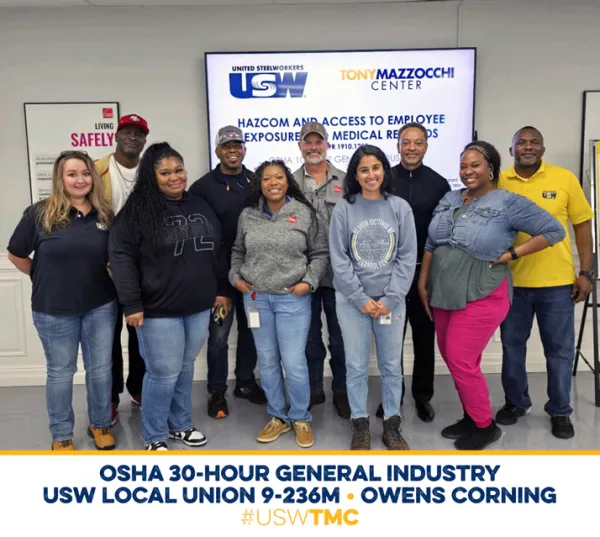
ES: Yes, with Kathie Warren (USW District 9 worker-trainer). The [OSHA] 30s go pretty smoothly most of the time, especially with experienced workers, but with young people, honestly, it can be grueling keeping their attention. Keeping them engaged is key. The trick is not to have one of them become overly dominant in the class. So, for example, you have to rotate who the report-back person is going to be. And you can’t just pick on people to read the materials out loud. Everybody is at different levels of comfort with that. You can kill a class pretty quickly if someone feels like they’ve been put on the spot. Also, your personal level of enthusiasm for the subject can hold the class together. Having good stories to tell works too.
RT: I agree. And introducing younger people to health and safety is key since they disproportionally suffer injuries at work. What other advice can you give us about training?
ES: Keep cool! Realize that most of the time you’re dealing with workers who have been conditioned to blame themselves for all sorts of things on the job. Let people know that you yourself have been in their place. Don’t strut around like an expert. Sit with them. Work together. Share the power.
RT: Excellent advice. Thanks so much, Eddie.
ES: You bet!